
Top 5 Cities Driving Indonesia’s Import-Export Growth: A Guide for SMEs
.png)
Currency Exchange Rate Calculator


Indonesia, Southeast Asia’s largest economy, continues to emerge as a global trade powerhouse. Its vast archipelago is home to several dynamic trade hubs powering the nation’s import-export growth.
For businesses and SMEs seeking entry or expansion into Indonesia, understanding the nation's top import-export cities is crucial. This article explores the top import export cities Indonesia, with insights into their major commodities and growth opportunities for small businesses.
🔑 Read More: 2026 Cross-Border Payment Trends – How SMEs Stay in Control
Jakarta: Indonesia’s Primary Trade Gateway
Opportunities doing business in Indonesia’s manufacturing and logistics centre
Jakarta, the country’s capital, stands as the beating heart of Indonesia’s international trade. Home to Tanjung Priok Port, the nation’s busiest and most advanced maritime gateway, Jakarta dominates both import and export activities.
- Trade Volume: About 20.66% of all Indonesian imports enter through Jakarta, primarily machinery and mechanical equipment, with the value totalling over $20.76 billion in recent months. The volume reflects Jakarta’s critical role in supplying parts and technology for Indonesia’s manufacturing sector and infrastructure projects, which depend on timely, large-scale importation from international partners.
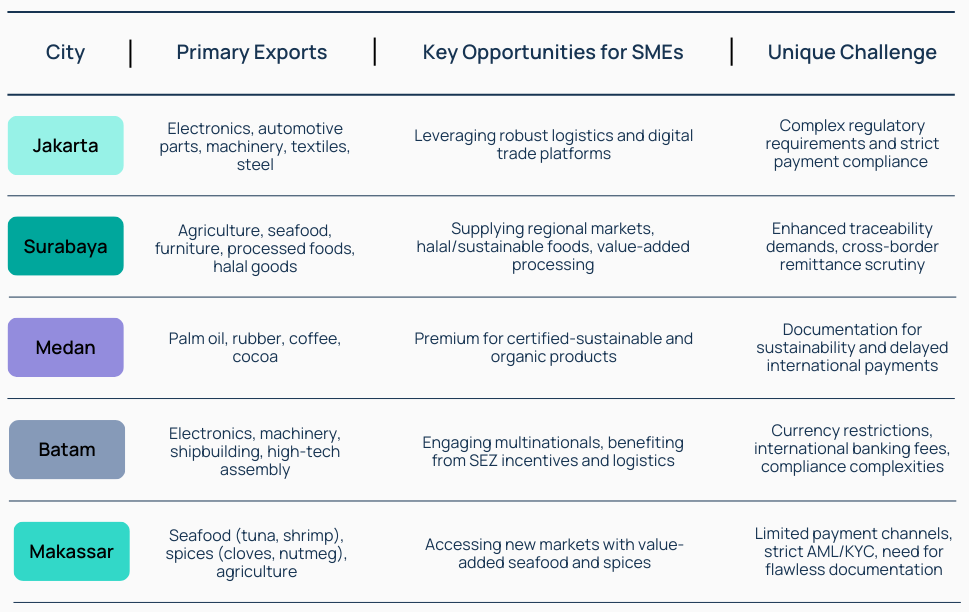
- Major Commodities: Jakarta’s economy centres on high-value manufactured goods, ranging from electronics and automotive products to textiles and steel. Electronics hold a dominant position, frequently shipped to key markets in Asia, Europe, and North America. Automotive parts and fully assembled vehicles, produced in Jakarta’s sprawling industrial zones, are in growing demand, while textiles and garments make up a resilient segment, feeding global fashion supply chains. Iron and steel exports, used in construction and heavy industry, also contribute significantly to Jakarta’s export ledger.
- Resilient Amidst Volatility: The global economic climate in 2025 has seen fluctuations influenced by supply chain bottlenecks and shifting demand, but Jakarta’s trade flows have proven robust. Non-oil and gas exports through Jakarta have shown resilience, indicating Jakarta’s capacity to adapt and supply evolving global needs.. Indonesia’s total export value in May 2025 stood at $24.61 billion, up 9.68% year-on-year, with machinery and electrical equipment among the top growth drivers.
- New Government Schemes: In 2025, the Ministry of Trade and other state bodies have rolled out digital export facilitation initiatives, streamlined export licensing, and new financing options tailored for business owners. These include online platforms for faster documentation approval, low-interest export loans, and training programmes to help companies execute international transactions more efficiently. Government partnerships with local banks also aim to connect exporters directly with overseas buyers, making payment processes more transparent and reducing administrative delays.
Jakarta’s unique blend of infrastructure and government support makes it the centrepiece of the export landscape in Indonesia. Business success in this vibrant market is built on understanding complex trade regulations, payment systems, and documentation requirements. With growing demand in electronics, automotive, and textiles, Jakarta remains the focal point for companies pursuing major Indonesia export markets and seeking to unlock new Indonesia business opportunities.
Surabaya: Eastern Indonesia’s Trade Powerhouse
Opportunities doing business in Indonesia’s agricultural and halal export sector
Surabaya, the largest city in East Java, anchors eastern Indonesia’s international trade with its dynamic port and thriving production sectors. Tanjung Perak Port, the second-busiest in the country, provides the gateway for a vast array of exports that have made Surabaya indispensable to Indonesia’s global supply chains.
- Strategic Location: Surabaya’s position on Java’s north coast offers direct shipping access to regional growth markets across Asia, cutting transit times and reducing costs for exporters. Its location makes it a preferred starting point for vessels heading towards China, Japan, and fellow ASEAN nations.
- Key Commodities: The local economy thrives on agricultural exports such as coffee, cloves, tapioca, and fresh produce, as well as a robust fisheries sector including seafood and shrimp. The furniture industry also plays a major role, with skilled craftsmanship from Java attracting buyers from Europe and North America. Surabaya’s export profile is rounded out by processed foods and other value-added goods.
- Halal & Sustainable Commodities: Surabaya has distinguished itself by meeting strict global standards for halal and sustainable product certifications. Local authorities have invested in traceability and compliance systems, making the city a reliable source for ethically produced foods and ingredients—particularly appealing to buyers in the Middle East and increasingly, Europe and Asia.
- Government Incentives: In recent years, policymakers have introduced targeted subsidies for cold storage facilities, which help preserve perishable goods for export. Streamlined customs clearance and fast-tracked export licensing enable local entrepreneurs to reach foreign markets more efficiently. Trade missions and exhibitions sponsored by government bodies connect Surabaya’s producers directly with international buyers, supporting further growth.
- Modern Infrastructure: Investments in Tanjung Perak Port and the broader city have dramatically improved cold chain logistics and warehouse management. Exporters now benefit from quicker vessel turnaround times and reduced spoilage rates, which are critical for high-value agricultural and seafood products. These advances firmly position Surabaya as a competitive export hub on the world stage.
Surabaya is pivotal for those looking at new Indonesia business opportunities or evaluating where to do business in Indonesia’s agricultural and halal sectors. While its strategic location and modern logistics open doors to lucrative export Indonesia prospects, exporters must maintain vigilance over payment processes, documentation, and regulatory compliance. Competitive success in Surabaya’s dynamic export markets relies as much on harnessing infrastructure advantages as on mastering international payments and Indonesia trade regulations.
Medan: Gateway to Sumatra’s Exports
Opportunities doing business in Indonesia’s agro-industry and sustainable exports
Medan stands as Northern Sumatra’s export powerhouse, anchored by the bustling Port of Belawan. The city is a principal outlet for some of Indonesia’s most valuable agricultural commodities, with palm oil, rubber, coffee, and cocoa leading export categories. Medan has carved a reputation as Indonesia’s hub for certified sustainable palm oil, allowing local exporters to command premium prices and gain reliable access to environmentally conscious consumers across the globe. These certifications are increasingly mandatory for large international buyers, especially in Europe and North America.
- Palm Oil’s Vital Role: Medan’s exports of palm oil are essential to both local and national economies, with producers frequently achieving premium rates due to adherence to globally recognised sustainability standards. As certification and traceability have become prerequisites for many global customers, Medan’s ecosystem supports rigorous compliance and documentation.
- Growing Coffee and Cocoa Sectors: The city’s coffee and cocoa exports have seen strong growth, driven by local processing facilities that add value and create differentiated offerings for the international market. Roasted coffees, chocolate products, and specialty beans are some of the sectors experiencing expansion.
- Policy Support for Organic and Eco-Conscious Exports: In recent years, regional governments have championed sustainable agriculture, providing incentives for organic and eco-friendly production. These efforts are targeted at lucrative European and North American markets, where such attributes are increasingly non-negotiable for buyers.
Medan’s leadership in sustainable palm oil, coffee, and cocoa makes it a sought-after destination for anyone considering where to do business in Indonesia’s agro-industry. As an emerging hub for organic and premium goods, Medan offers optimal access to Indonesia export markets, provided business owners proactively meet global compliance standards, update export documentation, and adapt to changing regulations and currency conditions. Focusing on reliable payment and export tracking will help maximise the growing Indonesia business opportunities in Medan.
Batam: Free Trade Zone and Industrial Hub
Opportunities doing business in Indonesia’s electronics and free trade zone
Batam is Indonesia’s shining example of a Special Economic Zone, positioned strategically just south of Singapore. The city’s duty-free status is a magnet for global investors—especially those involved in electronics, machinery, shipbuilding, and hi-tech assembly. Batam’s advanced facilities and strong transportation links enable seamless access to global supply chains, making it a preferred site for multinational corporations and export-oriented manufacturers.
- Advanced Facilities: Businesses in Batam tap into modern industrial parks with cutting-edge warehousing, assembly lines, and direct shipping options, speeding products from factory floor to international buyers efficiently.
- Investor Attraction: Batam boasts financial and logistical advantages over other regional rivals, appealing especially to companies seeking alternatives to crowded or high-cost manufacturing centres. Its proximity to Singapore ensures fast turnaround and reliable connections to global markets.
- Electronics & Shipbuilding Growth: The city has seen robust expansion, with electronic component manufacturing and shipbuilding both attracting increased investment and fulfilling larger export orders.
Batam’s status as a special economic zone and its electronics sector position it among the best places for export Indonesia and international manufacturing activities. The tax and regulatory structures are attractive for anyone on the hunt for where to do business in Indonesia with a focus on technology and logistics. However, adapting to trade regulations and ensuring efficient multi-currency settlement will be the ingredients for sustaining success in this export market in Indonesia.
Makassar: Rising Hub in Eastern Indonesia
Opportunities doing business in Indonesia’s seafood and spice export region
Makassar, capital of South Sulawesi, has rapidly grown into a prominent export centre, thanks to extensive upgrades at Makassar New Port. The city is now a go-to hub for premium seafood exports as well as prized spices such as cloves and nutmeg. The government’s investment in infrastructure and cold storage has elevated the value, consistency, and reputation of Makassar’s exports, keeping products at peak quality for international buyers.
- Seafood and Spice Export Dominance: Makassar shines as a leading exporter of both premium seafood and spices. Local fisheries supply highly sought-after tuna, shrimp, and crab, while the surrounding hills and plantations yield quality cloves, nutmeg, and other prized spices. Modern processing facilities in the city ensure products meet rigorous international standards for freshness, safety, and traceability. Government-backed sustainability and food-safety certifications empower Makassar’s exporters to access lucrative markets in Japan, the EU, the Middle East, and North America, where demand for ethically sourced goods is on the rise. Producers regularly invest in value-added processing to secure price premiums and respond to buyers’ requirements for clean, fully documented supply chains.
- Connectivity to Eastern Indonesia: As the main port of the region, Makassar is crucial for connecting smaller islands and isolated producers to both national and global supply chains. The city acts as a logistics coordinator—aggregating shipments, providing export training to rural producers, and investing in regional transport links. This regional role helps decentralise Indonesia’s export activity, empowering smaller economies and bringing eastern products to wider markets.
- Regional Branding and Market Expansion: Makassar’s distinctive offering of fresh seafood and premium spices is amplified by active government marketing efforts in major international trade exhibitions. Support extends to branding campaigns, online marketplace integration, and assistance with export licensing and compliance documentation. By promoting sustainably harvested products, Makassar builds trust and recognition with international buyers, helping new entrants and established businesses achieve expanded reach.
Makassar’s ascent in seafood and spice exports makes it a compelling choice for businesses considering where to do business in Indonesia to access regional and global markets. However, success here hinges on careful management of cross-border payment logistics, compliance with Indonesia’s trade regulations, and keeping export documentation up-to-date. For those venturing into export Indonesia opportunities from the eastern archipelago, Makassar promises exceptional growth prospects with diligent compliance and payment strategy.
How Businesses Can Make Use of Export Opportunities When Doing Business in Indonesia
By making use of export opportunities when doing business in Indonesia, companies gain access to a dynamic economy fuelled by abundant natural resources, a thriving digital sector, and proactive government policies aimed at accelerating export growth.
For new entrants and established firms wondering how to start making use of these opportunities, the process involves:
- Identifying the right export sectors and strategic regions (e.g., manufacturing in Jakarta, agro-exports in Medan, electronics in Batam).
- Leveraging government initiatives such as tax incentives, export licensing support, and digital trade platforms to simplify compliance and reduce costs.
- Attending trade missions, exhibitions, and using local expertise to connect with global buyers and optimise product-market fit.
- Ensuring readiness to meet global standards in documentation, sustainability, and payment management for a smooth cross-border business journey.
🔑 Read More: Simplifying Global Payroll for Maritime Businesses with Bulk Payment
Optimising Cross-Border Payments for Indonesia Trade Hub
🔑 Read More: The Driving Force Behind APAC's Payment Innovation
As Indonesia’s top trade cities continue to power the country’s import-export growth, business owners continue to contend with a complex landscape of payment processing, regulatory compliance, and cross-border challenges.
From Jakarta’s demanding documentation standards to Surabaya’s traceability requirements, Medan’s sustainability compliance, Batam’s currency restrictions, and Makassar’s evolving payment channels, each city presents unique hurdles that can impact the speed, security, and profitability of international trade.
This is where solutions like Wallex take on the complexities behind the scenes to simplify the cross-border payment processes for your business.
Speak to us to manage all your cross-border payment needs from one platform and unlock the full export potential of Indonesia's dynamic trade hubs.
10-Minute Guide To Cashless Payments in South East Asia
Get insight into the economies of South East Asia. Understand the local payment platforms, how they’re being used, key features, transaction limits and more.
Download the business guide for Indonesia
Get insights to help your business tap in on the opportunities in Southeast Asia’s largest economy.


.png)
.png)